 |
 |
 |
|
 |
|
|
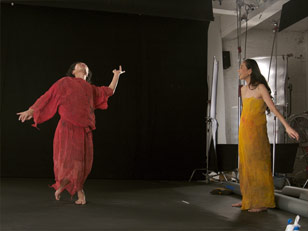
Karole Armitage
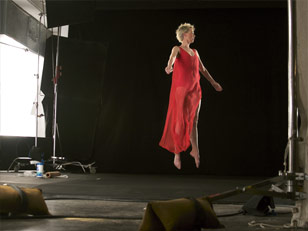
"There were some things that I thought would look incredible in slow motion that were boring, and
other things that were really interesting. I tried to do movement that would make the fabric fly,
like an accompaniment. I wanted to jump because it made an effect of rippling and bustling. I
tried to make big curves and find positions where the fabric would continue to flow in those
amazing waves."
|
|
Alexandra Beller
"For the film I think I did quite full-bodied, meaty, passionate, hungry movement. I just went for
it: big, flying, turning, dropping, hair flying—kind of animalistic. When I saw it slowed
down, it was so beautiful. Of course you say you want to move with liquidity, but as a human being
with lots of bones and joints, it's not as easy as it sounds. And all of a sudden there it is.
Real total liquid. There was a bead of sweat that dripped down at one point. When you take those
details out of the expectation of time, they are so surprising and magical."
|
|
Roxane Butterfly
"I saw an aspect of me that I could not suspect. I was completely removed from the sound. The
sound is such a big part of how I'm perceived as a dancer. In a way you could hear the echo, just
imagining what the sound could be through the composition of the movement, the face, the skin, the
feet, the hands, the texture. When I dance, people tell me that I look like I'm floating, but I
always feel like I'm stuck on the floor, I always feel heavy. My whole quest is to get to the
point where I'm flying. And I saw that, I thought 'I am flying!'"
|
|
|
 |
|
 |
|
 |
|
|
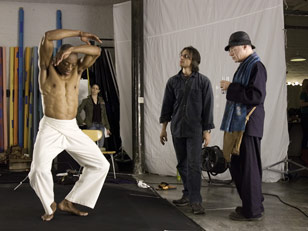
Gabriel "Kwikstep" Dionisio
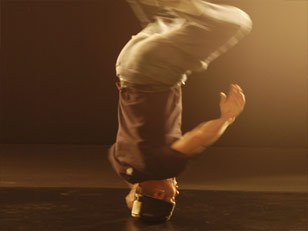
"When I'm doing headspins it almost feels like time standing still. People get to see what it
takes for me to hold that position. I learned about how my body automatically adjusts itself to
get into the formation, and how it takes advantage of centrifugal force. Watching my dancing
slowed down, I think an audience will be able to appreciate the artistic form of breaking."
|
|
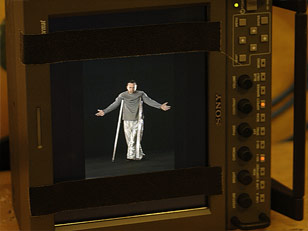
Bill Shannon (Crutchmaster)
"In the film, I do a threaded type of movement. I cross my arm across my chest, the crutch goes
down to a 45-degree angle in relation to the floor, then I slide my leg in between my arm and the
crutch—I thread my arm through a triangle. Because the set-up is weird, it looks like I'm
about to trip over myself or something; it's kind of comical. I was trying to stay in bounds and
that changes the dancing. I was doing it tighter but it would've been the same if I was doing it
wide open. The transition was expanded in the slow motion because you never really see that
movement much. The continuation is there; it's just funny to look at."
|
|
Eiko and Koma
Eiko
"Usually we have one hour and here we had five seconds. We did it much faster than we usually
dance because otherwise what he's making is so slow that it becomes not moving. When I'm doing
something like this I'm concentrating on the plural. I saw the names who are doing this, it's our
whole field in participation. I don't attend a lot of marathon concerts, but this gives us quick
access to be included and to give our voice to the plural voices. We all exist in the same
time."
Koma
"Dancing in a performance and dancing for a camera are different things. The camera is capturing
the gesture, the shape, but it cannot capture the dancer's mind. Eiko and I don't consider
ourselves slow dancers. People ask me 'why you go so slow.' We answer 'we don't, we're just trying
to create movements that people enjoy.'"
|
|
|
 |
|
 |
|
 |
|
|
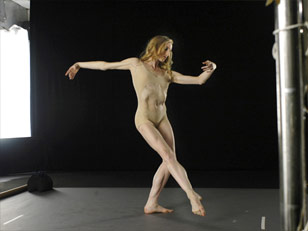
Bill T. Jones
"I was trying to do something with undulations and directional changes that would give some
insight into the way I move—the upper body doing one thing, the legs doing another. But four
seconds is not very much time to do anything. That was a revelation. We are so naked when we move.
It was kind of a gruesome thing to subject a performer's ego to, but ultimately I think that's
what's very beautiful about it. It was one of the hardest things I've ever done. If one element
fell through, everything was erased. It was a bit of a Zen test."
|
|
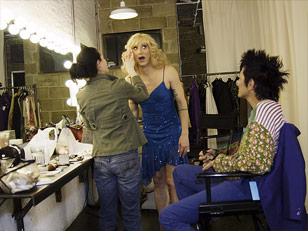
Glen Rumsey (Shasta Cola) and Elizabeth Streb
Glen Rumsey
"I had on a silk chiffon old-style dressing gown that's long and flowy and I'm spinning. It almost
looks like water. I rarely create movements for Shasta, she's mainly an improv individual. Because
it was such a specific amount of time to make our statement, I did have to think, 'I want to do a
change of level, I want to do a turn or two, and I want to end in an uplifted way.' It was
exciting, I was like 'who is that?' It looks angelic and dream-like."
Elizabeth Streb
"It was so painful to watch myself slowed down. Dancers are like magicians who are able to have a
sleight of hand, they direct where you look. I think it's possible to almost impose the surprise
[so] that the audience goes 'how did you do that?' 'Cause they can't see mechanically how you did
it. It's more that you are tricking the people watching with a timing system where they don't
notice or something happens so fast. So when all of those moments slow down, it shows everything I
try to hide."
|
|
Wendy Whelan
"What I did for the camera was a simple class combination. I found that the less I did the better
for me. It was sissons [a type of jump] mostly. I felt, when I looked at myself, youthful and
hopeful and reaching for higher, but definitely imperfect—which I didn't mind. I knew I had
to let that go. I felt like each person gave a little poem in their film. Everyone had a story and
a mood. They were all so different and I fell in love with each of them so differently. Falling in
love with somebody's essence."
|
|






 En
En Fr
Fr